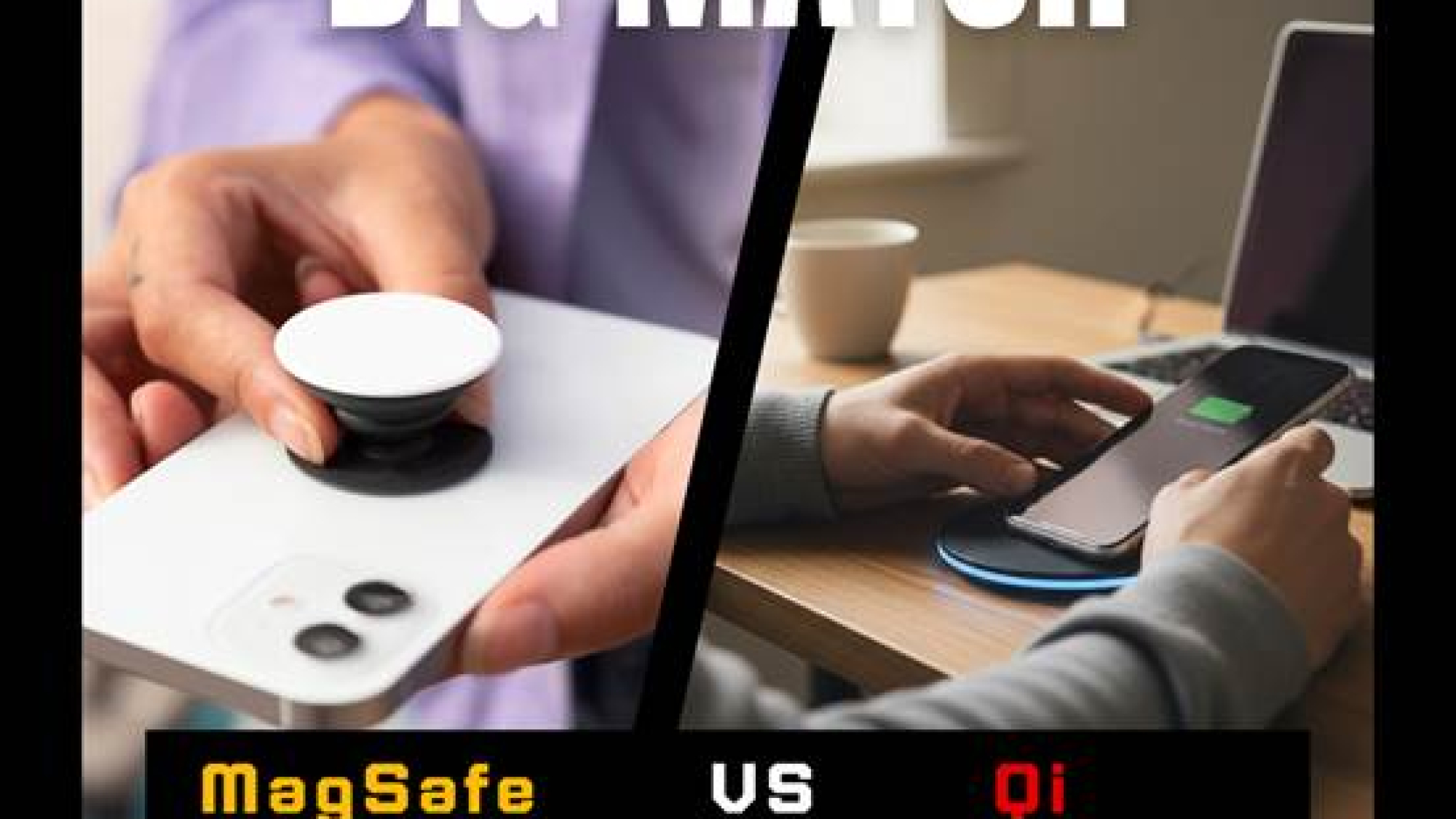
If you are shopping for a new wireless charger for your iPhone now, you may see boxes labeled "Qi-Certified," "Wireless," and "MagSafe." They all seem to charge your phone without a cable, but the prices and designs are different. What’s the real difference between a wireless charging pad and a MagSafe charger, and which one should you actually buy?
We're here to give you a clear, direct comparison. This article will explain the difference between MagSafe and standard Qi wireless charging so you can confidently decide which is better for you.
Before we compare, let's get a clear definition of both technologies.
What is Qi Wireless Charging?
Qi (pronounced "chee") is the universal, open standard for wireless charging. Think of it like "Wi-Fi" for power. If a device and a charger are both Qi-certified, they will work together, regardless of the brand.
This technology uses an inductive coil in the charger to send power to a receiver coil in your phone. Every iPhone since the iPhone 8, as well as flagship Android phones, uses Qi charging.
What is MagSafe?
MagSafe is Apple's proprietary technology, first introduced on the iPhone 12. It is built on top of the Qi standard but adds one key ingredient: a ring of magnets. This magnetic ring, built into both the phone and the charger, ensures the two coils snap into perfect, 1-to-1 alignment every single time.
MagSafe vs. Qi Wireless Charging: The 3 Key Differences
While both charge your phone, the experience and performance are very different. It all comes down to alignment, speed, and compatibility.
Alignment & Ease of Use
Qi:
You must manually place your phone on the charging pad, trying to find the "sweet spot" where the two coils line up. If you misalign it (which is easy to do, especially in the dark), you'll get a very slow charge, or it may not charge at all.
MagSafe:
This is MagSafe's biggest advantage. The magnets automatically guide your phone into the perfect charging position with a satisfying "snap." There is no guesswork. This perfect alignment also means you can pick up and use your phone while it's still charging, as it's securely attached.
Charging Speed
Qi:
Due to the risk of misalignment and potential overheating, Apple limits the speed of all non-MagSafe wireless charging for iPhones to 7.5W.
MagSafe:
Because the magnets guarantee perfect, efficient alignment, Apple allows MagSafe-certified chargers to deliver power at up to 15W—that's twice the speed of standard Qi charging.
Compatibility
Qi:
This is the universal winner. A Qi pad will charge your iPhone (8 or newer), your AirPods, and a friend's Samsung Galaxy or Google Pixel phone.
MagSafe:
The magnetic "snap" and 15W fast charging only work with iPhone 12 models and newer. A MagSafe charger can still charge an older iPhone (like an iPhone 11) or an Android phone, but it will only work as a standard 7.5W Qi charger, and it won't attach magnetically.
Which Wireless iPhone Charger is Better for YOU?
Let's make this simple. Here’s how to decide based on your phone and your needs.
You should get a MagSafe-compatible charger if:
- You have an iPhone 12, 13, 14, 15, or newer.
- You want the fastest possible wireless charging speed (15W).
- You love the "snap-on" convenience and want to use your phone while it charges.
You should get a standard Qi charger if:
- You have an older iPhone (like an iPhone 8, X, XR, or 11).
- You need to charge multiple devices, including Android phones or non-MagSafe AirPods.
- You are looking for a highly effective and budget-friendly charging solution for your desk or nightstand.
Don't Forget the Power Adapter!
This is a step most people miss. To get those top speeds, you need the right power source.
- To get 15W from a MagSafe charger, you must plug it into a USB-C power adapter that is 20W or higher.
- To get the max 7.5W from a standard Qi charger for your iPhone, you also need a power adapter that can supply it (typically 10W or higher).
If you use an old 5W adapter (the little white cube that used to come with iPhones), your charging speeds will be incredibly slow, no matter which wireless charger you use.
Use Advanced Charging Technology with Huntkey
So, MagSafe vs. wireless charging: which is better?
To get the best of MagSafe's "snap-on" convenience, even on the go, we recommend a portable solution. Huntkey's magnetic power bank series is the perfect companion for your iPhone 12 or newer.
- For a slim, pocket-friendly daily boost, check out the MG01-5K (5000mAh).
- For maximum power for travel or long days, the MG01-10K (10000mAh) has you covered.